TechVault
B2B Enterprise Technology-Discovery Platform · Energy Sector
Traffic that arrived, looked, and left
A live B2B platform with healthy traffic, weak retention and few demo bookings. The design looked fine; the structure did not hold.
TechVault connects buyers and suppliers in the energy sector, helping businesses discover and evaluate technology solutions. When I joined it had traffic but low engagement depth and almost no conversion momentum.
Stakeholders knew performance was underwhelming. Nobody had defined why. The instinct in the room was that the interface needed refreshing.
It was not a visual problem. It was structural clarity and conversion alignment.
What that actually cost
Categories nobody thought in
Technology categories were cluttered and organised the way the catalogue was stored, not the way a buyer searches. Users had to translate their problem into the site's vocabulary before they could start.
The CTA arrived too late
The primary demo booking action was not visible at the moment a user decided they were interested. People explored and left without the platform ever asking for the conversation.
Features, not relevance
Technology pages described what a tool did rather than what it changed for the buyer. Users saw specifications; they did not see themselves.
What I had to design around
A live revenue-carrying platform, a stakeholder group that wanted the login wall kept, and a timeline that shrank mid-project.
Live platform, real customers
Nothing could go dark for a redesign. Every change had to ship against a running product with existing users and existing suppliers.
The login wall was policy
Forced sign-in on technology pages was treated as lead capture. Removing it meant arguing against a rule the business believed was earning it money.
Timeline compressed mid-flight
The delivery window shrank after scoping. IA restructuring, PRDs, developer handoff and release support all had to land inside it anyway.
Execution discipline mattered as much as design thinking.
Client identity under NDA
The work is real; the branding is withheld. Screens in this case study carry neutral identity rather than the client's.
Rebuild the path, not the paint
Evidence first, then IA, onboarding, authentication, and a prototyping loop fast enough to argue with.
Find out where attention actually died
I ran stakeholder interviews to surface the revenue pressure behind the brief, then talked to real users to understand how they arrive at a shortlist. Heatmaps showed where attention collapsed and which controls were never touched.
What the evidence covered
- Stakeholder interviews to uncover revenue pressure and growth expectations
- User conversations to understand intent and decision flow
- Heatmap review of scroll depth, dead zones and unused filters
What I chose, and what it cost
Three calls that shaped the release, and three things I would do differently next time.
I lost the first argument twiceRemoved the forced login on exploration
Technology pages became browsable without an account, with sign-in requested at the point of genuine intent instead of on arrival.
Fewer raw sign-ups at the top of the funnel, and a stakeholder argument I had to win on principle before there was data to back it. Post-release reporting showed meaningful bounce reduction.
Structural fixes before new features
I argued the roadmap toward demo-flow simplification and onboarding clarity, and pushed non-critical enhancements behind them.
The roadmap looked slower for a quarter. Nothing new shipped that a stakeholder could point at while the foundations were being repaired.
Outcome language over feature language
Technology pages lead with what changes for the buyer rather than what the tool contains.
Every supplier page needed rewriting, which is slower than a template swap and depends on suppliers describing their own value honestly.
What I'd fix
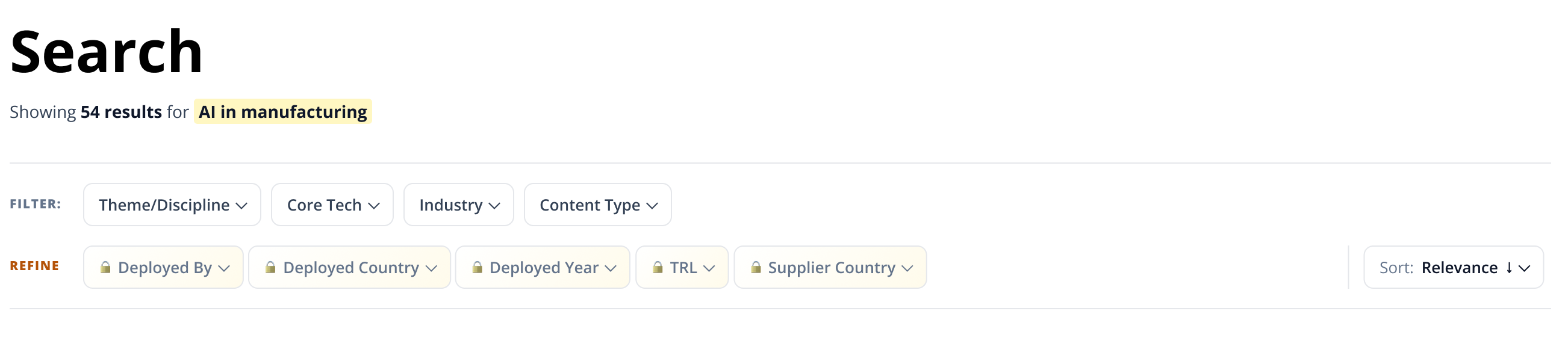
The search redesign is approved but still in engineering, so the honest win here is the onboarding and auth work, not the filters. I should have shipped the smallest useful slice of the new search early rather than holding the whole thing for one release.
The deployment-proof view still gates almost everything behind a plan. Turning ‘Deployed by 1 company’ into real credibility meant surfacing aggregate counts and sectors up front, and I left that behind the wall.
I leaned on stakeholder reporting for the bounce and demo numbers rather than instrumenting the funnel myself. Next time I wire the events first, so the before and after is mine to prove rather than mine to quote.
Where it landed
Demo interaction up, drop-off down, and a validation loop the team kept using after I left the project.
These are the numbers the business reported after release, not numbers I instrumented. I have flagged that gap above rather than presenting them as measurement I own.